Loading documentation…
System architecture
How the clinic app, backend, workers, data stores and NEAR payment controls fit together.
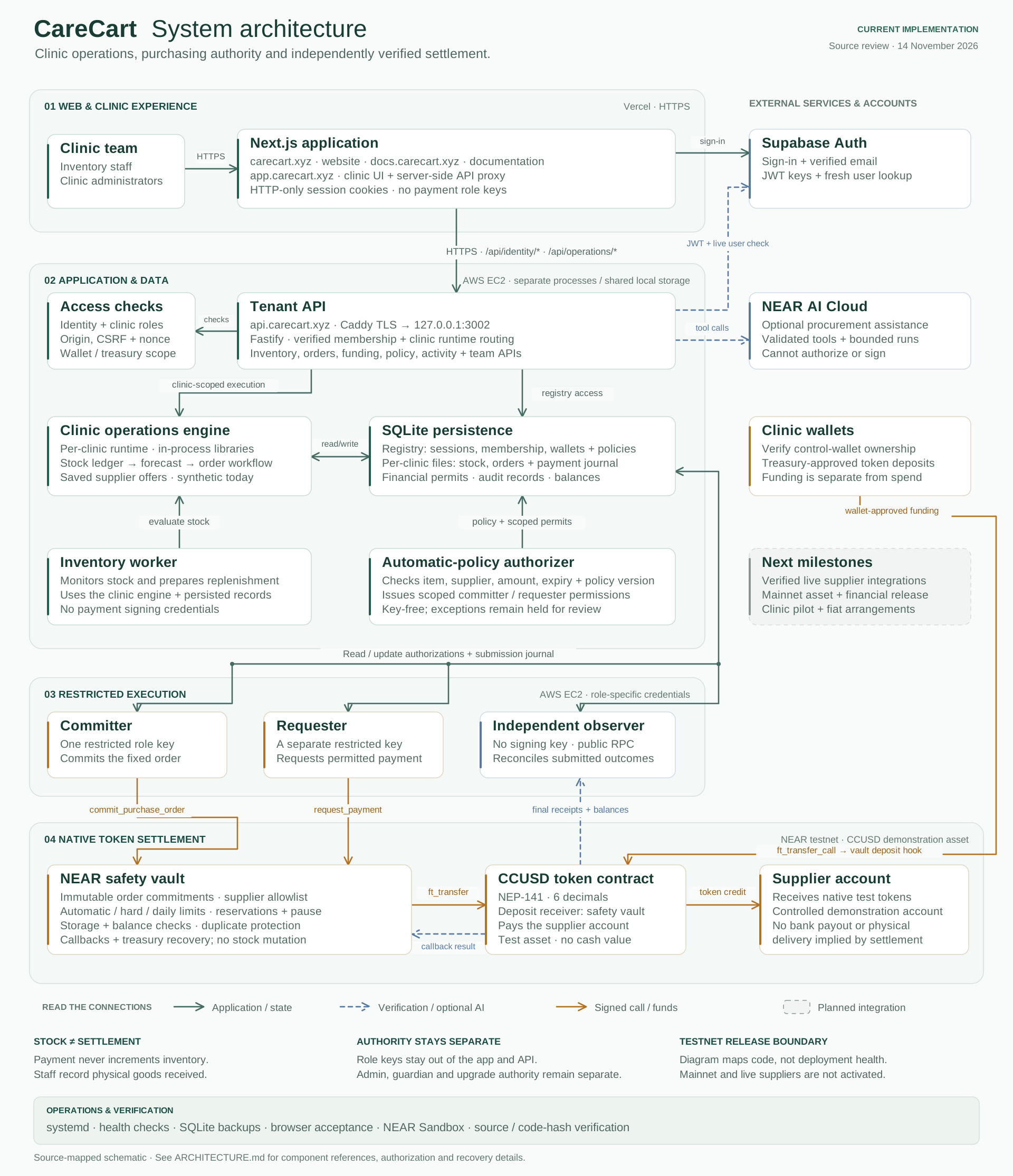
CareCart separates stock records, purchasing authority, payment signing and independent verification. The architecture below maps the implemented system; optional services require configuration, and the diagram does not certify live deployment health.
Application and identity
The product website, documentation and clinic app share a Next.js deployment with separate public hosts. Supabase manages sign-in. The tenant API independently verifies identity and clinic membership before routing a request to that clinic’s runtime.
The browser does not select an arbitrary database or grant itself a clinic role. The server binds each request to the verified clinic and required permission.
Inventory and purchasing
The stock ledger records receipts, usage and adjustments in a separate clinic database. Background monitoring evaluates those records, compares saved offers and prepares a fixed order.
A separate deterministic policy evaluates the current item, supplier, amount, expiry and authority before issuing scoped permissions. Optional AI assistance can interpret needs and propose a next step; it cannot grant spending permission or sign a payment.
Payment execution
The committer and requester run separately, each with its own restricted role key. One commits the reviewed order; the other requests its permitted payment. The safety vault checks supplier permissions, limits, reservations, available funds and pause status before calling the configured token contract.
A key-free observer checks final chain evidence and reconciles submitted operations. Staff record physical receiving separately: settlement never adds stock automatically.
Data and operations
SQLite stores clinic membership, policy versions and per-clinic operational records. Supabase supplies identity rather than serving as the inventory database. Backup, restore rehearsals, service monitoring and credential custody remain operational responsibilities.
Administrative and upgrade authority are separate trust assumptions. Restricted payment keys do not remove the need to govern the people who control hosting and contract upgrades.
Release boundary
The current public payment path uses CCUSD on NEAR testnet, with synthetic offers and a controlled supplier account. Mainnet, live distributor connections and fiat settlement are separate milestones.
Developers can inspect the component guide and source links. Clinics can start with safety and data and mainnet readiness.